Blog

Research
A mixed-methods study of 32 paramedic students found higher empathy scores after two brief programs. See what the research found—and what it cannot yet tell us.
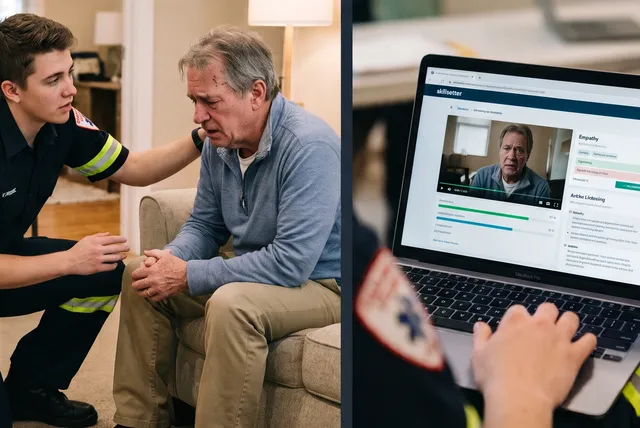
A 2025 mixed-methods study of Australian paramedic students found that empathy scores were higher after two brief empathy-education programs—one didactic and one based on deliberate practice. The study used Skillsetter to present standardized patient scenarios and record student responses for assessment. It did not test Skillsetter against another platform or isolate the platform’s effect; it examined two teaching approaches delivered by the research team.[1]
32 paramedic students completed the study, randomly allocated to didactic education (18) or deliberate-practice education (14).
Both groups’ mean scores on a measure of expressed empathy increased from baseline to post-education: 4.29 to 4.88 on a 0–8 scale overall.
The study found no statistically significant difference in improvement between the two education approaches.
In interviews, students described greater flexibility and the therapeutic value of empathy; deliberate-practice participants also described the feedback process as challenging but useful and valued a slower, more human approach.
The findings are promising, but the small volunteer sample, lack of a control group, and absence of longer-term follow-up mean they should be interpreted as early evidence—not proof of lasting change or better patient outcomes.[1]
Paramedics may be among the first health professionals to meet someone experiencing mental-health distress. Yet the researchers note that paramedic students can receive more training on recognizing presentations and following clinical guidelines than on how to communicate with a person in distress. Empathy—the effort to understand another person’s experience and communicate that understanding—may be especially important when a patient’s needs are not solved by a quick clinical intervention.[1]
The study asked three practical questions: Can a short empathy program improve paramedic students’ expressed empathy? Does didactic teaching or deliberate practice lead to greater improvement? And how do students experience each approach?
The research team recruited 42 students enrolled in Australian paramedic degrees; 32 completed all study steps. Participants were randomly assigned to a didactic group or a deliberate-practice (DP) group. Each program consisted of two online 45-minute sessions, approximately a week apart.[1]
Students responded to three simulated prehospital scenarios: an older woman experiencing grief and depression after her husband’s death, an adult woman experiencing auditory hallucinations, and a young man experiencing a panic attack. At each assessment point, participants watched a video prompt and recorded how they would respond as a paramedic.[1]
The didactic sessions taught foundational knowledge about empathy, its clinical benefits, and examples of empathetic responses. The DP sessions used a different format: participants watched a recording of their response, received individualized feedback from a trained educator, and tried the response again. The DP training focused on first-level empathy, including identifying explicit emotions and relevant context.[1]
Skillsetter supported the study by hosting the scenario videos and allowing participants to record their responses. Researchers assessed baseline and post-education recordings with the 10-item Measure of Expressed Empathy, which rates verbal and nonverbal behaviors on a 0–8 scale. The rater was blinded to participants’ group and whether a recording was taken before or after education. Researchers also interviewed 13 participants—six from the didactic group and seven from DP—about their experience and learning.[1]
Across both groups, the average empathy score rose from 4.29 before education to 4.88 afterward. The reported main effect of time was statistically significant, F(1, 30) = 7.84, p = .01. The didactic group’s mean increased from 4.24 to 5.03; the DP group’s mean increased from 4.36 to 4.96.[1]
The researchers did not find a statistically significant interaction between time and education type, F(1, 30) = 1.33, p = .26. In practical terms, this study did not show that one program produced greater improvement than the other. That is not the same as proving the methods are equivalent; a larger study designed to test equivalence could answer that question more directly.[1]
The interviews added context to the score changes. Didactic participants described valuing flexibility over a rigid script and seeing empathy as part of care—not simply a “soft” communication extra. Some said the training helped them feel more confident adapting when a conversation did not follow a set sequence.[1]
DP participants described the experience as confronting but beneficial. Watching their own recordings and practicing in front of others could feel intimidating, but participants also valued receiving specific feedback and immediately trying again. They described repetition as helping them build a response step by step. Another theme was a slower, more human approach: listening first, resisting the urge to rush toward a fix, and giving the patient’s story room.[1]
These are participants’ accounts of their learning experience, not evidence that every student will respond the same way. Still, they point to a useful design consideration for empathy education: explain the skill and why it matters, then give learners supported opportunities to practice it.
The study offers encouraging early evidence that short, targeted empathy education can be followed by measurable improvement in paramedic students’ responses to simulated patients. It also shows the value of combining performance measures with learner interviews: the scores describe what changed in the recorded responses, while the interviews help explain what students noticed and how the teaching felt.[1]
Important limitations remain. There was no control group, so the design cannot rule out practice effects from completing repeated video responses. The sample was small and made up of volunteers, who may have had a particular interest in mental-health care. The final recordings were completed within two weeks of the last session, so the study does not establish whether gains lasted. Nor did it measure clinical behavior on the job or patient outcomes. The authors recommend future research with control groups, longer follow-up, and qualified paramedics.[1]
The researchers acknowledged Skillsetter for allowing them to use the online skill-building platform. In this study, the platform provided a consistent way to show simulated patient scenarios and capture learners’ responses; the research team delivered the education and conducted the assessments. That distinction matters: the paper evaluates education programs, not Skillsetter as a standalone intervention.[1]
At Skillsetter, we make the platform available to academic researchers at no cost. We do this to give back to the academic community and to deepen our shared understanding of which interpersonal skills matter and how they can be developed. We’re glad the platform’s scenario-based, repeatable practice format could support a study using randomized allocation, blinded ratings, and mixed quantitative and qualitative methods.
For us, research use is part of a broader commitment: interpersonal skills should be teachable, observable, and open to rigorous study. The Waltrich and colleagues paper is one example of how researchers can use structured scenarios and recorded responses to examine skill development—while still being careful about what the evidence does and does not show.
In this study, paramedic students’ average expressed-empathy scores increased after two brief education programs. Because there was no control group and no longer-term follow-up, the result is promising but does not establish that the programs alone caused lasting change.[1]
The researchers found no statistically significant difference in improvement between the two groups. The study was not designed to prove that the methods are equivalent, so it does not establish that either approach is universally better.[1]
Skillsetter hosted the simulated patient videos and recorded participants’ responses. The research team delivered the didactic or deliberate-practice education and assessed the recordings.[1]
No. The study measured empathy in responses to simulated scenarios, not patient outcomes or on-the-job paramedic behavior. Those are important questions for future research.[1]
Yes. Skillsetter makes platform access available to researchers at no cost. Researchers interested in using it for a study can contact the Skillsetter team.
Waltrich, N. J., Sheen, J., Ling, M., & O’Shea, M. (2025). Developing empathy in paramedic students using didactic and deliberate practice education programs: A mixed-methods study. The Internet Journal of Allied Health Sciences and Practice, 23(4), Article 28. https://doi.org/10.46743/1540-580X.2707.
Continue reading
Blog
Blog
Blog

Blog

Blog

Blog
